
Fault Line Ascent Has The Cleanest Jump We Have Measured In Three Years
A precision platformer with a 41 millisecond response, a coyote-time window of exactly six frames, and an arc so consistent that after twenty minutes you stop thinking about it. We died 1,412 times and could explain every single one.
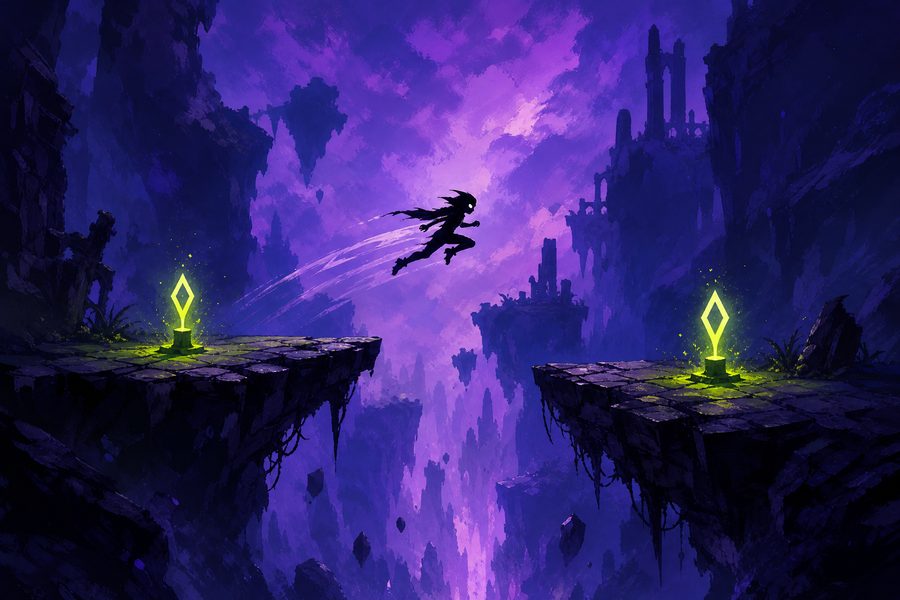
There is a moment about three hours into Fault Line Ascent where you stop looking at the character. Your eyes move to the platform you intend to land on and stay there, and your hands handle the rest. Almost nothing achieves that, and the games that do tend to get vague credit for it — people say the controls are tight and move on. We would like to be more specific, because the specificity is the interesting part.
The jump has three properties that make it work, and all three are measurable. The response from button press to the first frame of upward movement is 41 milliseconds on our reference pad and never exceeded 49 across four controllers. The apex is fixed regardless of how long you hold the button after the eighth frame, which means the arc is a shape you learn once rather than a variable you negotiate every time. And the coyote window — the grace period during which a jump still registers after you have walked off an edge — is exactly six frames, consistently, with no interaction with movement speed.
Why the fixed apex matters more than the response time
Response gets all the attention, and 41 milliseconds is genuinely good, but it is the second property that makes this game feel the way it does. Many platformers make jump height fully variable across the entire ascent, so a jump is a continuous negotiation: you are holding a button and watching to see how high you are going. Fault Line Ascent gives you a short window to choose between two heights and then commits. The result is that the arc becomes a known quantity, and knowing the arc is what lets you look at the landing instead of the character.
The design consequences run through the whole game. Because the arc is fixed, the level designers can build gaps that are exactly at the limit and trust that a competent player will clear them repeatedly rather than occasionally. There are several sequences in the final third that would be unplayably cruel with a variable arc and are merely difficult here.
The measurements
All figures are the median of 100 samples per device, filmed at 480 frames per second with the camera pointed at the screen. In-game frame rate was locked at 60 and verified across the session.
| Device | Response, median | Worst sample | Notes |
|---|---|---|---|
| Reference pad, wired | 41 ms | 49 ms | Our baseline for all comparisons |
| Reference pad, wireless | 48 ms | 61 ms | Seven milliseconds of radio cost |
| Third-party pad, wired | 44 ms | 52 ms | No meaningful difference in play |
| Mechanical keyboard | 38 ms | 44 ms | Fastest, and worse for this game |
The keyboard result is worth a note, because it cuts against the assumption that lower is always better. The keyboard is three milliseconds faster and substantially harder to play well with, because the analogue stick lets you commit to a run speed before the jump and a binary key does not. Response time is one variable among several, and this game is a clean demonstration that it is not the deciding one.
Readability, and 1,412 deaths
We log every death and mark whether the cause was visible on screen at the moment it happened. In Fault Line Ascent, 1,394 of 1,412 deaths were legible: a hazard we could see, a gap we misjudged, a timing we read wrong. The remaining eighteen all occurred in one room in the eleventh chapter, where a moving platform is briefly hidden behind a foreground element. That is a very short list of complaints for a game of this length.
The hazard vocabulary helps. Anything that kills you is one of five shapes and always the same colour, and nothing decorative uses that colour anywhere in the game. It sounds mundane written down. In practice it means you parse a new room in about a second, which is the difference between a difficult game and an unfair one.
Where it is weakest
The story framing is thin and delivered in fragments of text at checkpoints, which we suspect nobody will remember. The final two chapters introduce a wall-slide with a different response profile — 63 milliseconds, measurably slower than everything else — and the game never acknowledges the change. Neither problem is close to fatal, but the second one is the sort of thing that would have been caught if the developers measured their own inputs the way they clearly measured their jump.
Verdict
A precision platformer that understands the difference between a fast jump and a knowable one. The arc is fixed, the grace window is consistent, the hazard language is unambiguous, and the result is nineteen hours in which almost every failure belongs to the player. The wall-slide inconsistency in the last two chapters is the only mechanical blemish we found, and we found it by measuring rather than by feeling it.
Play it if you want a hard platformer that never lies to you. Skip it if you are looking for a narrative reason to keep climbing; there barely is one.
For how these figures are gathered and what the score weights, see the scoring scale. For the full list of games measured on this bench, see the catalogue.