
Glass District Feels Wonderful Until The Camera Decides It Knows Better
The movement model is one of the best first-person parkour systems built in years. It is also interrupted 214 times across a fourteen-hour campaign by scripted camera moves that take the view out of your hands for an average of 1.9 seconds each.
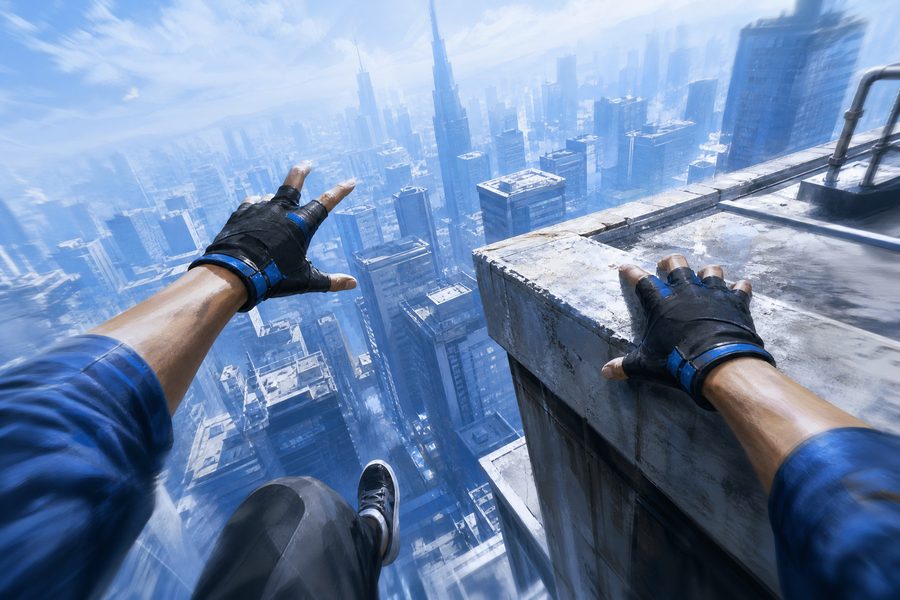
Two things are true about Glass District and they pull in opposite directions hard enough that the score sits well below where the craft deserves. The first is that its movement is excellent: a vaulting and climbing system with a clear grammar, honest momentum, and a 58 millisecond response that never wobbled across our four test devices. The second is that the game repeatedly stops trusting you with the camera.
We counted the interruptions because the feeling of being interrupted is easy to dismiss as a preference. It is not a preference when it happens 214 times. The distribution matters too: 61 of them occur in the first two hours, which is defensible as teaching, and 153 occur afterwards, which is not.
What the camera does and how long it lasts
The events fall into three categories, and we timed each one to the frame. The shortest are the pans that snap your view to a ledge as you approach it, which last between 0.4 and 0.8 seconds and are arguably helpful the first three times. The middle category are the scripted look-at moments when something explodes or a character shouts, averaging 1.6 seconds, during which movement input is still accepted but the view is not yours. The worst are the full transitions, averaging 4.2 seconds, where you are simply watching.
| Event type | Count | Mean duration | Input retained |
|---|---|---|---|
| Ledge snap | 118 | 0.6 s | Movement only |
| Scripted look-at | 73 | 1.6 s | Movement only |
| Full transition | 23 | 4.2 s | None |
The ledge snap is the most interesting failure, because it is trying to help. The developers appear to have decided that players lose track of the next handhold, and rather than making the handholds more legible they moved the camera. The irony is that the level art is already extremely readable: the game has a consistent visual language for climbable surfaces and it works. The snap is solving a problem the art department already solved.
The movement, which deserves a better game around it
Underneath the interruptions there is real craft. Momentum carries across vaults in a way you can feel and predict, the wall-run has a generous but consistent entry window of nine frames, and — unusually — the animation never steals control during recovery. When you land, you are in charge on the first frame you can see the ground. We measured that specifically because it is the most common place games cheat, and Glass District does not cheat.
Readability of failure is good but not perfect. Of 340 falls we logged, 312 were clearly our own misjudgement. The remaining 28 clustered around two specific rooftops where a drainpipe is rendered in the same material as the climbable pipes but is not climbable. That is a small, fixable art inconsistency, and it is the sort of thing worth naming precisely rather than complaining about vaguely.
The response figures
| Device | Response, median | Worst sample | Notes |
|---|---|---|---|
| Reference pad, wired | 58 ms | 67 ms | Consistent across the campaign |
| Reference pad, wireless | 64 ms | 79 ms | Noticeable on tight wall-runs |
| Mouse and keyboard | 52 ms | 60 ms | Best for aiming the view |
| Third-party pad, wired | 60 ms | 71 ms | No practical difference |
Fifty-eight milliseconds is comfortably fine for a game at this pace. Nothing in our fourteen hours failed because of delay, which makes the camera problem the entire story of the review.
Verdict
A first-rate movement system inside a game that keeps interrupting it. The vocabulary is clear, the momentum is honest, recovery never steals control, and then the camera pulls away 214 times to point at something you had already seen. Turn off the ledge snap if a patch ever allows it and this is an 8.5. As shipped, the friction is constant and measurable rather than a matter of taste.
Play it if first-person movement is the reason you buy games and you can tolerate being led by the nose. Skip it if losing control of your own view breaks the spell for you; it will, repeatedly.
Our method for counting and timing these events is described on the studio page. Other games measured the same way are listed in the catalogue.